
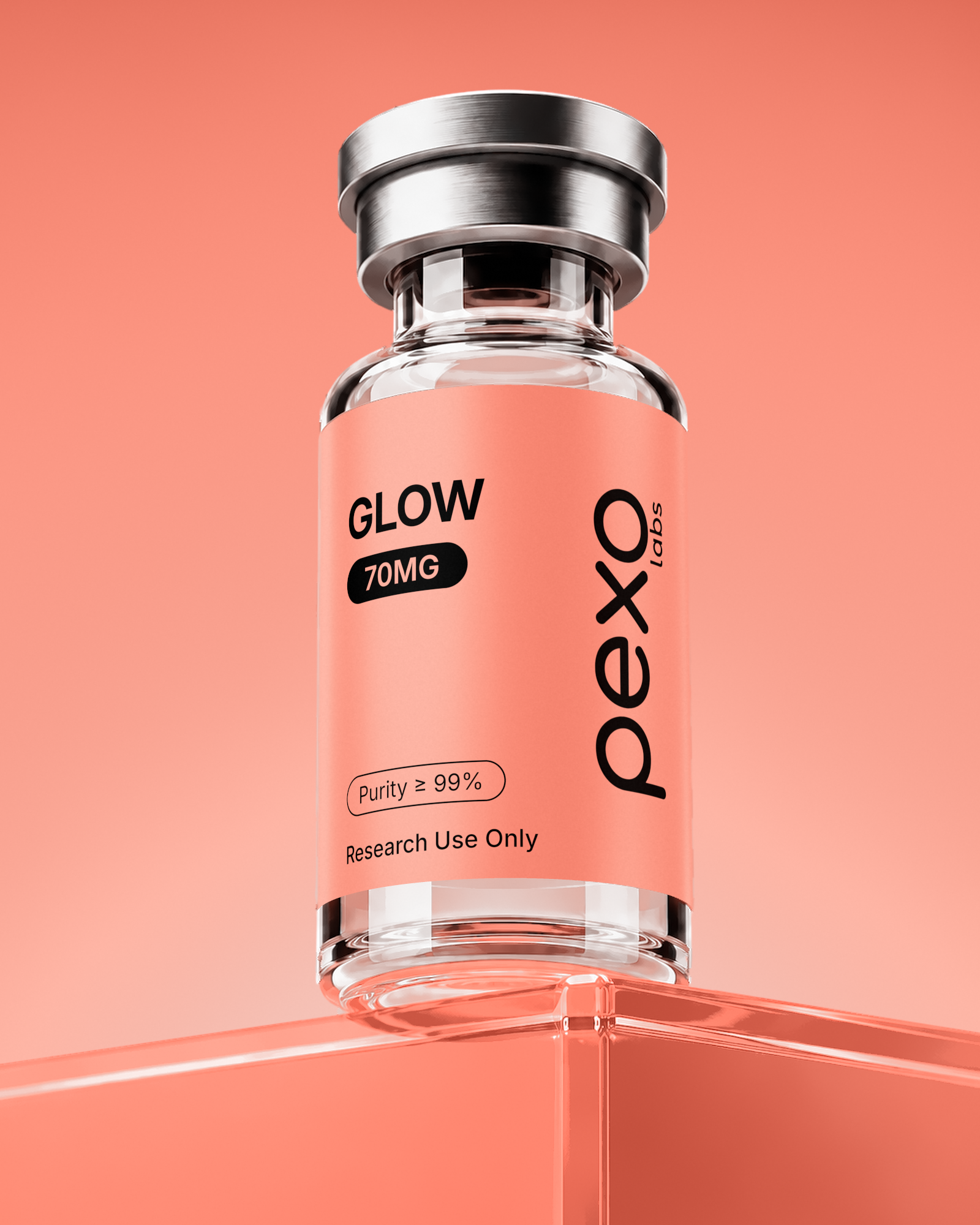







Description
| Blend Name | GLOW |
| Components | GHK-Cu + BPC-157 + TB-500 |
| Number of Components | 3 |
| Appearance | Lyophilized blue powder (copper(II) complex) |
| Form | Lyophilized powder (single vial) |
| Purity | ≥99% (HPLC, each component) |
| Compound Name | GHK-Cu (Glycyl-L-Histidyl-L-Lysine Copper Complex) |
| CAS Number | 89030-95-5 (copper complex) |
| Molecular Formula | C₁₄H₂₄CuN₆O₄ |
| Molecular Weight | 403.93 g/mol |
| Sequence | Gly-His-Lys + Cu²⁺ (1:1 stoichiometry) |
| Origin | First isolated from human plasma (Pickart, 1973) |
GHK-Cu is a tripeptide-copper(II) complex first isolated from human blood plasma in 1973. The copper ion is coordinated by the glycine α-amino nitrogen, the deprotonated amide nitrogen of the Gly-His bond, and the histidine imidazole nitrogen in a square-planar arrangement, with a reported stability constant of log K ≈ 16.4.
GHK-Cu is the largest component of this blend by mass and accounts for the blue color of the lyophilized powder, which arises from the d–d electronic transition of the Cu(II) center and gives a broad visible absorbance band near 615 nm in solution. The complex is pH-labile: it is stable dry and in neutral solution but releases copper under acidic conditions. A full compound profile is available on the standalone GHK-Cu product page.
| CAS Number | 137525-51-0 |
| Molecular Formula | C₆₂H₉₈N₁₆O₂₂ |
| Molecular Weight | 1,419.53 g/mol |
| Sequence | GEPPPGKPADDAGLV (15 amino acids) |
| Origin | Partial sequence of human gastric juice protein |
A synthetic pentadecapeptide with the sequence of a 15-residue fragment of a protein identified in human gastric juice, first described by Sikiric et al. (1993) at the University of Zagreb. Proline-rich (26.7%) with a contiguous Pro-Pro-Pro triplet that gives the backbone an unusually rigid, extended conformation. Acidic (net charge ≈ −2 at neutral pH), freely water-soluble, and containing no aromatic, sulfur-containing, or amide-side-chain residues. A full compound profile is available on the standalone BPC-157 product page.
| CAS Number | 77591-33-4 |
| Molecular Formula | C₂₁₂H₃₅₀N₅₆O₇₈S |
| Molecular Weight | 4,963.44 g/mol |
| Sequence Length | 43 amino acids (N-acetylated, full-length) |
| Origin | First isolated from calf thymus tissue (1960s) |
The synthetic form of full-length thymosin β4, a 43-residue acidic, intrinsically disordered member of the β-thymosin family containing the conserved LKKTET actin-binding motif at residues 17–22. N-terminally acetylated on Ser-1, with no tryptophan, tyrosine, or cysteine and a single methionine at position 6. A full compound profile is available on the standalone TB-500 product page.
The three components are co-lyophilized at the quantities stated on the label and the Certificate of Analysis. They span a 12-fold range in mass (404 to 4,963 Da) and differ in charge and hydrophobicity, so they are readily resolved from one another by reversed-phase HPLC and by mass spectrometry. Each component’s purity and net content are reported separately on the certificate.
GHK-Cu
Very polar; elutes early. Under acidic HPLC conditions the copper dissociates and the peak observed is free GHK ([M+H]⁺ m/z 341.2). Copper is measured separately, e.g., by ICP-OES or visible absorbance near 615 nm.
BPC-157
Acidic, mid-eluting. Principal ions at m/z 1,420.5 ([M+H]⁺) and 710.8 ([M+2H]²⁺). No chromophore above 230 nm; detect at 214 nm.
TB-500
Largest component; later-eluting. Multiply charged envelope near m/z 1,241.9 ([M+4H]⁴⁺), 993.7 ([M+5H]⁵⁺), and 828.3 ([M+6H]⁶⁺). Contains Met-6, the only oxidation-prone residue in the blend.
Two handling points specific to this mixture. First, none of the three peptides contains tryptophan or tyrosine, so the blend cannot be quantified at 280 nm; use 214 nm or MS for the peptides and the visible band for the copper complex. Second, copper(II) can catalyze oxidation of methionine to methionine sulfoxide (+16 Da) in solution. Although the copper in GHK-Cu is tightly chelated, prepared solutions should be protected from light and air and used promptly, and a minor TB-500 sulfoxide peak may appear in aged solutions.
| Blend | Components | Total Peptides | Key Difference |
|---|---|---|---|
| BPC-157 + TB-500 | BPC-157 + TB-500 | 2 | Two-component base mixture (TB-500 supplied as fragment) |
| GLOW | GHK-Cu + BPC-157 + TB-500 | 3 | Adds copper(II) tripeptide complex; blue powder |
| KLOW | GHK-Cu + BPC-157 + TB-500 + KPV | 4 | Adds KPV, a 342 Da basic tripeptide |
GLOW is the three-component member of the blend lineup. Note that the TB-500 in the BPC-157 + TB-500 blend is supplied as the 7-residue Ac-LKKTETQ fragment, whereas GLOW and KLOW contain the full-length 43-residue peptide; the two forms differ five-fold in mass and are not interchangeable in analytical work.
Every lot is tested by an independent third-party laboratory. The tests below correspond to the results reported on the Certificate of Analysis linked on this page. Refer to the certificate for the values for the specific lot.
Purity (HPLC, per component)
Reversed-phase HPLC with low-wavelength UV detection. Each peptide is resolved and its purity reported separately. Specification ≥99% by peak area for each component.
Net Content (per component)
Content of each peptide per vial determined by HPLC peak area against its labeled quantity. Specification 90–115% of label claim for each component, evaluated individually.
Appearance
Visual inspection of the lyophilized material against the specification of a blue lyophilized powder, reflecting the copper(II) complex.
Certificate Verification
Each certificate carries a verification code that can be checked directly on the issuing laboratory’s website.
Storage Conditions
Lyophilized (powder): -20°C, protected from light and moisture. Stable for 24+ months under recommended conditions. The copper coordination complex (GHK-Cu) remains intact in the dry state.
Handling: allow the sealed vial to reach room temperature before opening to avoid condensation. Prepare laboratory solutions in water or neutral buffer, protect them from light and air, and avoid repeated freeze-thaw cycles.
Product Summary
- Three-component lyophilized peptide blend
- GHK-Cu (CAS 89030-95-5) — copper(II) tripeptide complex
- BPC-157 (CAS 137525-51-0) — proline-rich pentadecapeptide
- TB-500 (CAS 77591-33-4) — full-length thymosin β4
- Blue lyophilized powder (copper content)
- Components resolved and quantified separately by HPLC
- Third-party tested by Amino Metrics
- Certificate of Analysis published on this page
⚠️ Research Notice
This product is for laboratory and research use only. It is not intended for human or veterinary use and is not intended to diagnose, treat, cure, or prevent any disease. This product is not a pharmaceutical product and is not sold for any clinical indication.
All chemical, structural, and analytical information on this page is sourced from published scientific references and the product’s Certificate of Analysis. It is provided for educational reference only and should not be interpreted as medical advice or product claims.
By purchasing this product, you confirm that you are a qualified researcher and that this product will be used strictly for in-vitro research purposes in compliance with all applicable laws and regulations.